
Buying Guide · 9 min read
Do I Need a Website If I Already Have Instagram?
What a website does that a social profile structurally can’t, and when Instagram alone is genuinely still enough.
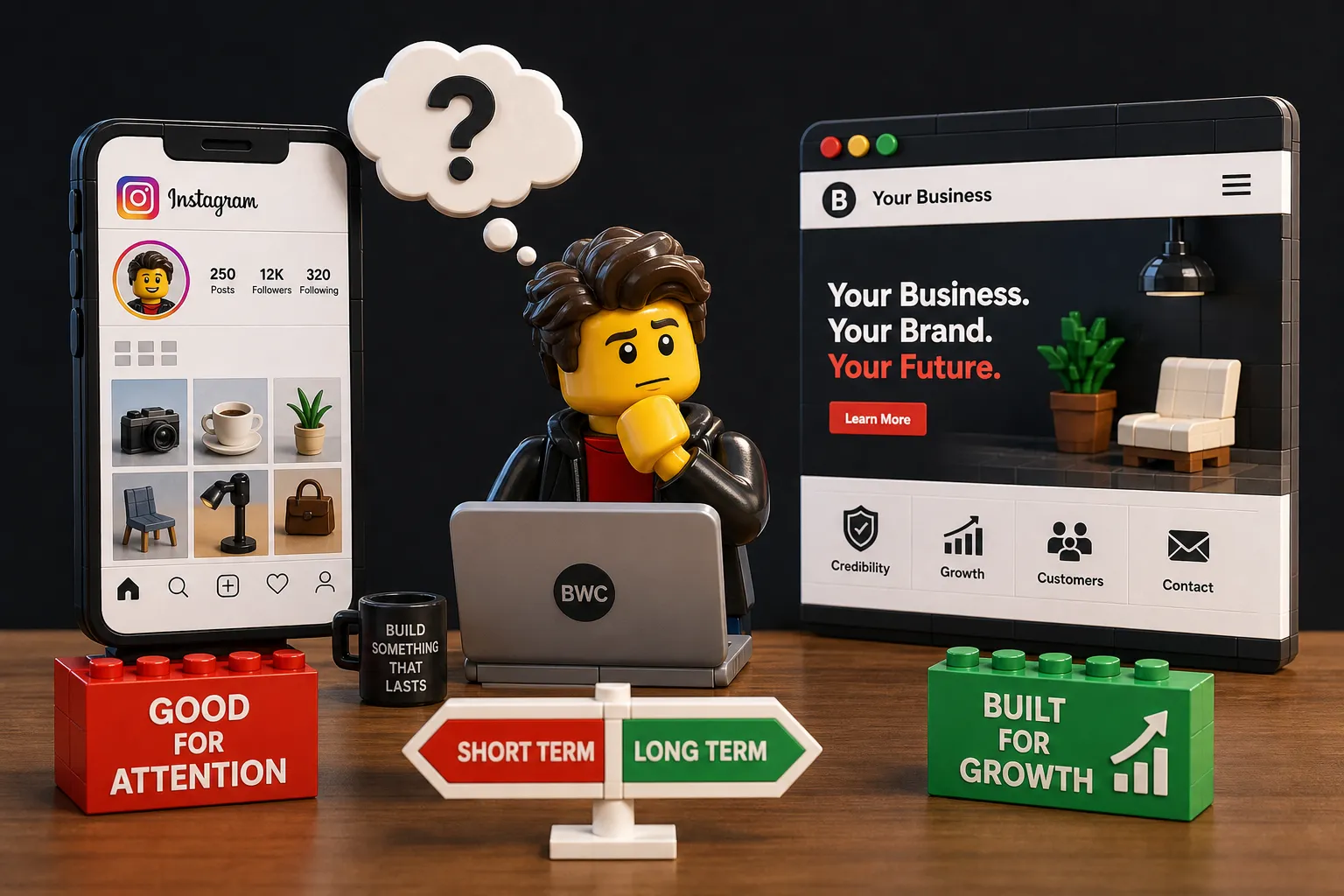
Instagram is working for you. You're posting consistently, your follower count is climbing, and the occasional DM inquiry turns into a real client. The idea of building a whole website on top of that feels like a project you don't have time for, an expense you can't quite justify, and honestly, a solution to a problem you're not sure you have. This is one of the most common conversations we have with small business owners who've built genuine traction on social media — and it's exactly the right question to ask.
So, do you need a professional website if you already use Instagram for your business? The honest answer is: almost certainly yes, but the reasoning matters more than the conclusion. Instagram is a legitimately useful business tool, and nothing here argues otherwise. But there are structural limits to what any social platform can do for your business, and understanding those limits clearly is what lets you make a smart decision.
What Instagram genuinely can't do for your business
This isn't about opinions on Instagram's aesthetic or debates about the algorithm. There are specific platform mechanics that affect your revenue and growth in measurable ways.
For most organic posts, Instagram defaults to a single bio link — the one clickable destination available to businesses without paid promotion or shopping tags. For a business trying to direct customers to a booking page, a specific service, a product, or a contact form, that single link creates real friction. A salon owner trying to get appointment bookings has to choose between linking to a homepage, a scheduling tool, or a link-in-bio hub that asks the visitor to make another choice before they get anywhere useful. Compare that to a website, where a customer searching Google for a haircut in their area lands directly on a booking page with one button to press.
Instagram content also has very limited indexability compared to website pages. When someone types “freelance copywriter for SaaS companies” or “best florist in Austin” into a search bar, Instagram profiles rarely appear in those results in any meaningful way. This matters because search traffic and social media traffic represent two very different types of intent. Someone scrolling Instagram is in discovery mode; someone searching Google is actively looking for what you offer. Organic search reaches people who are ready to buy, and Instagram, by design, reaches people who weren't necessarily looking for you at all.
Your reach on Instagram is also not guaranteed, and it's not yours. The platform regularly adjusts how it weights content types, which accounts it surfaces, and what percentage of your followers actually see any given post. One algorithm shift can cut a business's organic reach significantly overnight, and creators and businesses alike have experienced dramatic drops with little explanation and no recourse. For a business that relies on consistent lead flow, building your primary discovery channel on a system you have no control over is a meaningful risk.
The real risk of building your business on rented ground
Beyond the mechanics of reach and links, there's a more fundamental issue: the difference between a channel you own and one you rent. Think of it as the difference between a storefront you lease and one you hold the deed to — if the landlord changes the terms, you're the one scrambling.
An email list is an audience you own. If you move platforms, change your business model, or simply need to reach your customers directly, that list comes with you. Your Instagram followers, by contrast, exist inside a platform you don't control. If Instagram introduced paid-only reach for business accounts tomorrow, or simply lost relevance the way other platforms have before it, that audience doesn't transfer. A website with a well-placed email capture gives you a contact list that belongs to your business, regardless of what any platform decides to do next.
Instagram can also restrict or remove business accounts for policy violations, including accidental ones, with very little recourse and no guaranteed timeline for resolution. For a business that runs primarily through DMs, story links, and profile discovery, losing account access can mean losing the ability to communicate with customers instantly — user reports of sudden suspensions without clear explanation are well-documented across business communities. A website, on the other hand, is an owned channel you control: your content, your contact forms, and your booking pages stay up regardless of what happens to your social accounts, though standard hosting agreements and applicable laws still apply.
What a professional website actually gives you
The case for a website isn't simply “it makes you look professional” — that's too vague to act on. The real case is mechanical: here are three specific things a website does that Instagram structurally cannot.
Credibility that a profile can't replicate: when a potential customer finds you through a referral or a Google search, the first thing many of them do is look for your website. A professional site with a clear services page, real testimonials, an about section, and a visible contact path signals legitimacy in a way a social profile simply doesn't. A business with no website prompts a specific question in the buyer's mind: is this real? Some buyers will move on rather than take the risk of reaching out to a business they can't verify.
Organic search visibility that keeps working for you: a well-structured website page can rank for relevant search terms and send qualified traffic for years after it's published. According to industry benchmarks aggregated across multiple traffic studies, organic search typically accounts for between 29% and 53% of website traffic depending on business type, while social referral traffic sits around 5% to 7% of that total — with Instagram representing only a fraction of that already-small number. For local businesses especially, appearing in “near me” searches is where real customer discovery happens.
A conversion path you design and control: a website lets you build the full buyer journey — someone discovers you through search, reads your services page, sees testimonials and real photos, then books a call or submits a contact form. Every step is intentional, and every step is yours to optimize. The Instagram version of that journey has more friction by default: see a post, go to profile, click the bio link, land somewhere general, try to figure out the next step. Industry benchmarks from aggregated landing page studies put average conversion rates for service business booking pages around 13%, with strong performers reaching 20% or above.
Why Instagram and your website work better as a team
The point here isn't that Instagram is bad. It's that Instagram alone is insufficient for most businesses. The better framing is strategic: these two channels have different jobs, and they do those jobs better together.
Instagram is excellent for visibility, brand personality, and warming up potential customers who weren't actively searching for you. Your website is where those warm prospects go to evaluate whether they trust you enough to take action. A consultant who posts helpful tips on Instagram and links to a clear services page with a booking form gets the best of both channels — Instagram does the work of getting in front of people, the website does the work of turning that attention into a booked call or a paid inquiry.
A site designed to convert visitors coming from Instagram needs to load fast on mobile, communicate your core message immediately above the fold, and make the next step frictionless. The design process should start with what happens after the click: what does this person need to see, feel, and do in the next 30 seconds? A dedicated landing page matched to a specific Instagram campaign, featuring the same message and a single call-to-action, will consistently outperform sending that traffic to a general homepage.
How to get started without overcomplicating it
In practice, a focused four-page site that is well-designed and optimized will typically outperform a bloated ten-page site that lacks clarity or performance. The essential pages are a homepage with a focused message, a services or products page, an about page, and a contact or booking page. Your homepage needs to answer three questions that every new visitor has: what do you do, who is it for, and how do I get it? Most small businesses don't need a blog, an elaborate portfolio section, or a complex navigation menu on day one — they need a credible, fast, mobile-friendly presence that gives potential customers a reason to reach out.
A link-in-bio tool like Linktree can serve as a temporary bridge, particularly for businesses that are very early-stage or testing a concept before committing to a full site — they're easy to set up and better than nothing. But they don't rank on Google, they don't build credibility the same way a real website does, and they can't support a full buyer journey. Aggregated landing page benchmarks put dedicated landing pages at roughly 4% to 6% conversion on average, while link-in-bio pages typically see closer to 1% to 3% click-through on individual links. If your business relies on repeat clients or high-trust purchases, a link-in-bio tool is a useful patch, not a real foundation.
What a professional website costs in 2026
The range is wide and depends on how central your website is to your revenue. A DIY builder like Squarespace or Wix runs roughly $200 to $600 per year and takes a few days to a couple of weeks to set up yourself. A freelancer or template-based build costs between $500 and $8,000, with a typical timeline of two to six weeks. A full agency or studio build ranges from $5,000 to $35,000 or more depending on scope and complexity, with a timeline of one to three months. Spending $300 per year on a DIY site that quietly leaks potential clients is often more expensive in the long run than a proper build done once — our Website Cost Calculator can give you a realistic starting range for your specific situation in about two minutes.
The bottom line
If you're using Instagram for your business, you're doing something right — consistent visibility matters, and showing up on social media takes real effort. But Instagram is a channel, not a business asset you own. A professional website gives you the credibility, searchability, and conversion infrastructure that no social platform can replace.
The best approach isn't to choose between the two: it's to use Instagram to get in front of people, and your website to turn that attention into real business. Whether you start with a focused four-page site or invest in a properly built conversion-focused presence, the next move is to stop relying entirely on borrowed ground. If you're not sure what the right first step looks like for your specific situation, a free Online Presence Audit is a fast, no-cost way to see exactly where you stand right now.
Want this thinking applied to your business?
A free strategy call costs nothing and tells you exactly where you stand.