
Business Growth · 6 min read
Website Designer Pricing: What Small Businesses Should Expect
Quotes for the same website can range from $500 to $50,000. Here's what actually drives that gap, and how to compare quotes with confidence.
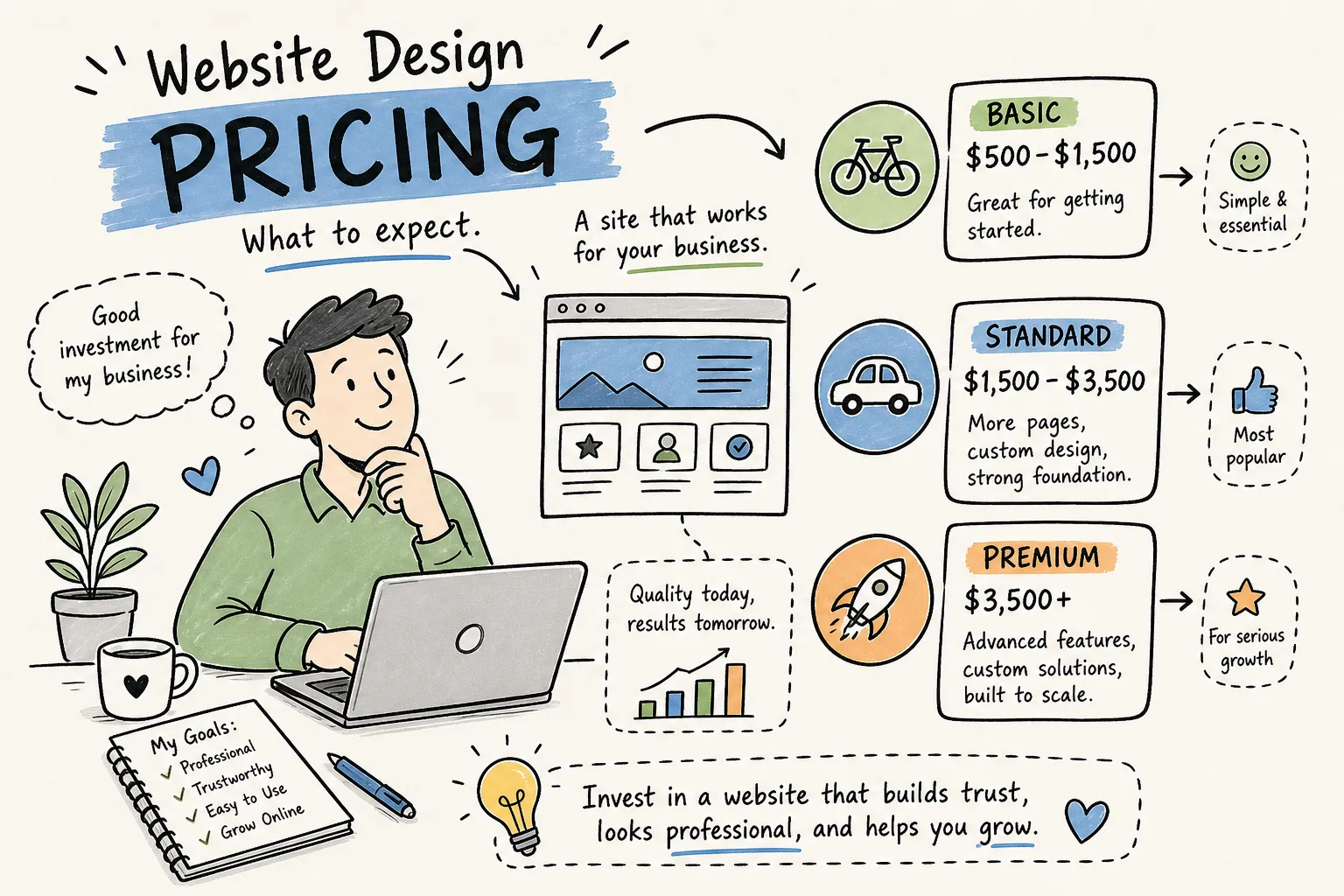
Website designer pricing is one of the most genuinely confusing corners of the internet. You can get quotes ranging from $500 to $50,000 for what sounds like the same deliverable: a website for your small business. That gap isn't random, and it isn't all about quality either. It comes down to three things: who builds it, how much customization is involved, and what the site actually needs to accomplish.
The Three Tiers of Website Designers
The web design market breaks into three tiers, each with a different pricing model, output quality, and working relationship. Knowing which tier you're talking to changes how you interpret a quote.
Freelancers charge $35–$125 per hour, with project rates for a basic site running $750–$5,000. That wide range reflects skill level, whether they're doing design only or design-plus-development, and how much strategic thinking is included. The tradeoff is real: lower cost in exchange for less structure and no single person owning the full outcome.
Boutique studios handle the full engagement (strategy, design, and development) without the overhead of a large team. For a custom business site, project pricing typically falls between $8,000 and $25,000. Better Website Co. operates in this tier: a founder-led studio offering custom, conversion-focused builds where one person owns every decision, without the price tag of an enterprise agency.
Large agencies generally start around $5,000 on the low end and run to $60,000 or more for complex, full-scope projects. What justifies that investment is the full team: dedicated project managers, UX researchers, QA cycles, content strategists. For smaller projects, some businesses find they're paying for resources they don't fully use, so it's worth evaluating whether the scope actually calls for that level of support.
What Actually Drives the Price Difference
Two quotes for a "5-page website" can differ by $10,000, and the gap almost always comes down to the same core variables. A template site uses a pre-built layout with style adjustments, which cuts design time and can reduce cost by $1,000–$3,000 or more. A custom site is designed from scratch around your brand and conversion goals. For businesses where the website is a primary sales tool, that isn't a luxury, it's an investment templates rarely replicate.
Specific features compound cost quickly. E-commerce functionality adds $2,000–$10,000 depending on product count and integrations. A standard CMS setup runs $300–$800, and responsive, mobile-first development can add up to $3,000 on its own. Scope is the biggest lever in any estimate, and a vague brief almost always produces an inflated quote because designers pad for uncertainty.
A $35/hour designer and a $125/hour designer aren't doing the same work. Higher rates reflect deeper strategy, cleaner code, faster delivery, and fewer costly revisions after launch. A cheaper build that requires a full rebuild within a year or two rarely ends up being the bargain it looked like at the start.
How Much Does a Website Cost by Site Type?
Simple brochure site (5 pages): $500–$5,000. A freelancer working with a template gets you to the low end. Most small service businesses should budget in this range unless they need active lead capture or e-commerce.
Lead-generation site (10–15 pages): $3,000–$15,000. This is where the investment starts producing clear ROI: service pages, case studies, a blog, contact forms, and SEO structure. It's also the most common engagement type for businesses using their website as a primary customer acquisition channel.
Small e-commerce site (50 products): $8,000–$35,000 or more. Product pages, cart and checkout flows, payment integrations, inventory management, and mobile performance all add complexity quickly.
The Costs That Don't Show Up in the Initial Quote
Most small business websites run $50–$300 per month in ongoing costs once live: hosting ($2–$150/month), plugin or CMS subscriptions ($100–$500/year), and routine maintenance. These are real budget line items, not afterthoughts, and any designer worth hiring will walk you through them before you sign.
Most web design quotes cover design and development, not the words or images on the site. Professional copywriting typically adds $500–$3,000 for a small site. Always clarify upfront whether a quote includes copy or assumes you're providing it; the answer changes your total investment significantly.
Questions to Ask Before You Sign Anything
What pages and features are included, and what triggers a change order?
Is the design custom or template-based?
Who owns the final files, code, and domain after launch?
What does the revision process look like, and how many rounds are included?
Will I be able to update the site myself after launch, and with what tool?
None of the three pricing tiers is universally right. A freelancer can be an excellent choice for a simple project with a tight budget. An agency earns its fee on complex, high-stakes builds. Many small businesses find the boutique studio tier strikes the right balance: custom strategic work, clean code, and a single point of accountability, without the overhead of a large agency or the unpredictability of a solo freelancer hired sight unseen.
At Better Website Co., every engagement starts with a free strategy call to scope the project accurately before any number goes on paper, so you leave with a clear picture of what your site needs, what it will realistically cost, and how the build will work.
Want this thinking applied to your business?
A free strategy call costs nothing and tells you exactly where you stand.