Branding · 9 min read
Better Website Co.: Who We Are and How We Build
Most small business websites look fine. But when a new visitor lands on the site, nothing happens. The site exists, but it doesn't work.
Most small business websites look fine. The colors are on-brand, the logo sits in the right corner, and the phone number is somewhere in the footer. But when a new visitor lands on the site, nothing happens. No inquiry, no booking, no call. The site exists, but it doesn't work. That gap between looking good and actually performing is exactly why Better Website Co. was built.
This studio isn't another web shop that opens Figma before understanding your business. Every project starts with one question: what does this website need to do for the business behind it? If you're a founder running on Instagram DMs, a local service business that Google can't find, or a consultant who needs to communicate authority the moment someone lands on your page, this is the work we do.
Strategy Comes Before Any Design Work Begins
The first thing Better Website Co. does with any new client is a scoped strategy call. Not a mood board, not a color palette discussion. Before a single wireframe is sketched, the team maps the client's business goals, identifies what drives their target customer's decision to buy, and locates every point of friction that causes a visitor to hesitate instead of take action.
Standard agencies typically start with a creative brief. The client describes what they want, the designer interprets it visually, and the site reflects the founder's preferences rather than the customer's psychology. A strategy-first process inverts that. The design serves the strategy, and the strategy serves the business goal. A conversion-focused website is one where every design decision exists to reduce the distance between a visitor's interest and their first action. Industry case studies and agency benchmark data support the impact of that kind of build.
Why Consumer Psychology Changes How a Website Performs
Most agencies optimize for how a site looks. The studio optimizes for how a visitor feels while moving through it. A visitor who lands on your site is running a fast, mostly unconscious evaluation: Does this business understand my problem? Can they actually help me? Is it safe to reach out? If any of those questions go unanswered within the first few seconds, a window UX research consistently puts at under five seconds, they leave.
Trust signals are built into the layout rather than bolted on as an afterthought. Ambiguity is removed at every key decision point. Conversion paths are engineered to match how real people actually make buying decisions, not how business owners wish they would.
The Businesses Better Website Co. Was Built For
Picture a business owner with a loyal following, hundreds of DMs a week, and zero owned web presence. Every sale runs through a platform that could throttle their reach, change its algorithm, or suspend their account without warning. Better Website Co. was built for the moment a founder is ready to stop renting and start owning their digital home.
The established barbershop, salon, tailor, or repair shop with a real customer base but no website loses potential clients every day. When someone searches their service plus their neighborhood, nothing shows up. Better Website Co. builds simple, fast, mobile-optimized sites structured around a single clear conversion action: a booking link, a phone tap, a contact form.
The studio also works with freelance consultants and coaches who need a site that communicates authority within the first few seconds, product founders who need a branded launch page without the complexity of a full e-commerce platform, and event promoters who need a high-urgency landing page with a countdown and a clear ticket CTA.
How a Project Actually Comes Together
The free strategy call is a working session, not a sales pitch. The team asks about your business goals, where your current inquiries come from, who your customer is, and where you're losing people in the buying process. By the end of the call, both parties have a clear picture of what the site needs to accomplish and whether the engagement is a fit.
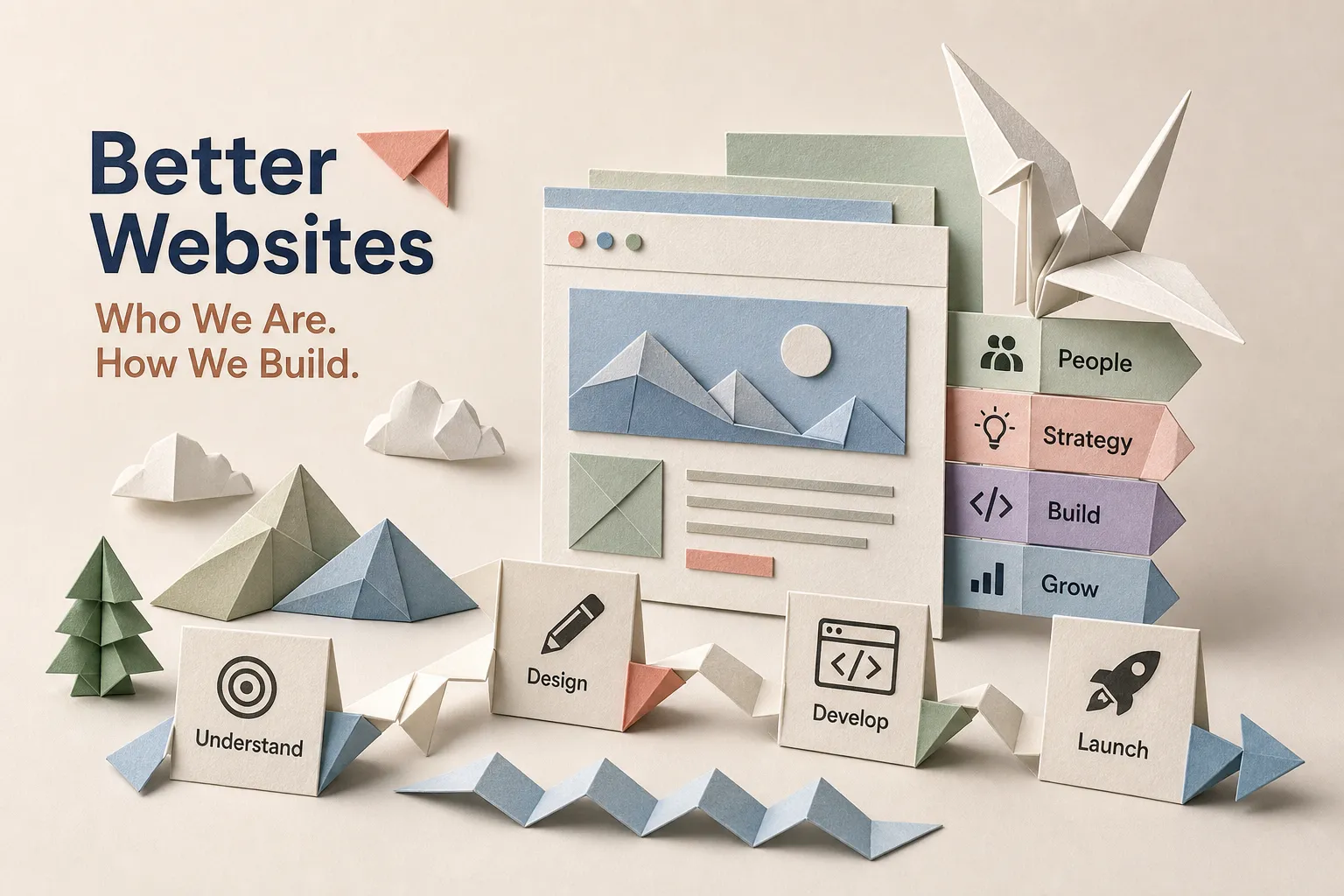
After the strategy call, the process moves through a clear arc: strategy and brief lock-in, information architecture, wireframe and layout, build with mobile-first clean code, client review, and launch. Two things matter most to small business owners throughout that process: speed and editability. The site loads fast and is structured so Google can understand it. The site is also client-editable after handoff, so owners can update their own content without calling a developer every time a service changes.
What Clients Actually Walk Away With
Clients walk away with a site that shows up on Google when someone searches their service plus their city, a mobile experience designed to convert visitors on a phone screen, and a site that communicates enough authority in those first critical seconds that a new visitor stays instead of bouncing to a competitor. The trust signals that drive those outcomes are built into the structure from the start: testimonials positioned near conversion points, real photos of the business and team, visible contact information, HTTPS security, and credentials that are easy to find.
Something happens to a founder's confidence when they have a real website. Proposals get accepted faster because prospects have already done their homework and arrived pre-qualified. Partners and vendors take the business more seriously because a professional web presence signals stability. That trust-building function is one of the most important outcomes of a properly built website.
Why We're Called "Better Website Co."
The .co extension was chosen deliberately. It's been used by credible brands ranging from startups to global companies, including Google (g.co) and Twitter (t.co), precisely because it signals something: modern, focused, and purpose-built. But the "Co." in the name carries more meaning than the domain suffix. It's short for company, collaborator, and co-builder. The studio sees itself as a business partner, not a vendor who hands over files and disappears. Survey data on TLD choice shows .com holds the strongest baseline trust and recognition, with .co a strong second among generic extensions — what you associate your name with matters far more than the three letters at the end of it.
Your Next Step
The strategy call is free. It runs about 30 minutes. By the end of it, you'll have a clear picture of what your site needs to accomplish, what a project would look like, and whether the fit is right. Too many small business websites are built to look good in an agency's portfolio rather than to work hard for the business behind them. Everything this studio does points to one founding belief: a website should be the most reliable salesperson a business has.
Want this thinking applied to your business?
A free strategy call costs nothing and tells you exactly where you stand.
Not sure where you stand?
Take the free Online Presence Audit →
Want to learn to do this yourself?
See the AI Business Academy →
More on Branding